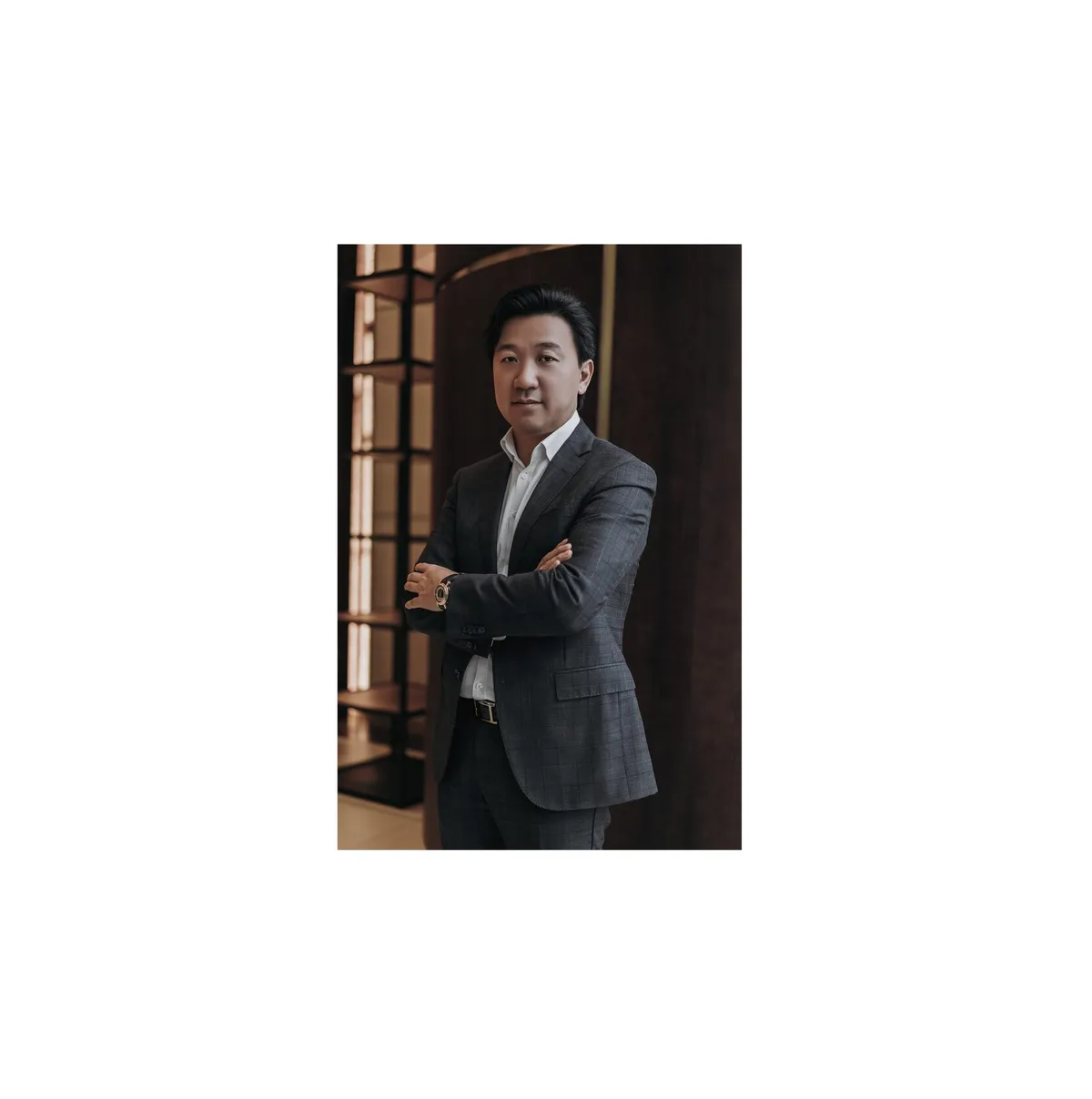
Eduard Bek: how LeePrime Group shapes the philosophy of a modern business model for investors in the construction sector
Serviced apartments — and with them hotels, inns and sanatoriums with developed resort and medical infrastructure — are a fast-growing segment of the real estate market. Investors are ready to put money into such properties if they meet high international standards, occupy advantageous locations and have a clear, well-defined management structure.
The experience and skills of the LeePrime Group team make it possible to produce an objective economic payback calculation for any property within optimal timescales: this helps achieve maximum results with minimum investment in construction projects.
— To understand how the company works, it helps to get to know its head. Tell us about your role at DirectPrime?
— I work in development and construction management, that is, directly on construction projects in hotel, health resort and medical services. And from the very first stage — from choosing the land plot for the property through to bringing it into operation.
Shaping the project, delivering the marketing strategy, positioning the brand within the industry, developing a business concept that accounts for every technological process — that is what LeePrime Group does. We take the idea the investor brings us and develop it into a well-thought-through, self-paying business.
— Hotels, apartments, inns, congress centres and any similar property demand particular attention and approach even at the business-idea stage, and yours is precisely the team that has all the competences and has already built an impressive portfolio of projects in this field.
— Yes, that is so. Let me explain by example. A hotel is not a place to sleep. It is a complex of very different services, with restaurants, spa and wellness offerings, and medical or wellness programmes. A hotel offers a whole range of formats for active and quiet rest. And for all these directions to work well together, it is not enough to put up a building and move guests into it. You need industry expertise to launch the property and take control of it.
— Let us imagine a potential investor who owns land in a very good location. The investor wants to build a hotel on that land. For that he needs your expertise and your competences. Under what circumstances are you ready to consider such a request?
— First of all we look at the location itself: it shapes the philosophy of the property. Understanding what makes the place particular, my colleagues carry out a deep marketing analysis: they study the competitive environment, the appeal of the area and the planning possibilities of the land plot. These data shape the business concept of the property, and from that concept comes the construction project itself.
— So your research produces an understanding of which business suits a specific location: for one area a sanatorium complex is ideal, for another a hotel?
— Exactly right. But that is speaking in very general terms. In reality there are far finer settings. Our marketers study the profile of the potential guest: it is from these data that an understanding emerges of what the hotel should be and what it should be filled with. By the time construction begins we know everything — what the room stock will be and what kinds of service there will be.
There are locations of a special category — almost historic ones, where a resort culture of their own has taken shape, their own environment, a particular society. People are used to coming there with a particular request. All of that is naturally taken into account, and a specific product is created for that audience. All these nuances are critically important. So of course we analyse, forecast and account for trends. And of course you cannot do without experience in delivering hotel properties and the business intuition that helps build a successful, long-term model. Sometimes it is the other way round: a completed hotel reformats the place and changes its historic character.
"There is a saying I like very much: often a hotel does not adapt to a place but shapes it, especially if it is built with a certain philosophy and soul. And that is true: we do not simply build hotel complexes, we create the story of a place."
— Every successful project of this kind is always about profit. So, for potential partners, let us talk a little about money. How does LeePrime Group's successful business model work, and what is a property's payback period — in broad terms.
— Domestic tourism is gathering pace right now — there is a construction boom in resort hotels and various apartment complexes. All of this is long-term investment, and we understand that payback takes quite a while. Everything depends on the concept, the room stock, the investment and the location. All our projects are fairly individual and there is probably no single formula for calculating payback. Everything is calculated case by case.
— Presumably payback is also affected by market mechanisms that regulate, among other things, the quality of the services the hotel provides? That is, until everything is running on rails, it is too early to talk about payback.
— Partly. There are long-standing industry quality standards — including for equipment. Some brands have left the market, and the remaining alternatives do not always meet our requirements. Searching for the right equipment affects timescales.
We have our own approach to launching projects, especially when we are talking about classic development, where the aim is to extract maximum profit precisely at the construction stage. Our approach to the business model is entirely different.
Often we look at certain engineering solutions not from the point of view of saving on investment, but from the point of view of saving on long-term investment — and that is a big difference.
We are convinced it is better to spend at the investment stage in order to get uninterrupted operation of the hotel complex afterwards. Net profit is always made up of the things we provided for in advance. Here are the factors that affect income: location — property — sound design — quality equipment — the highest level of service."
— You are saying that equipment equals quality of service delivered to the guest. In other words, cutting corners has a negative effect on the guest's experience in the hotel.
That is exactly so. A good hotel is a service plant running 24/7. So any breakdown leads to disruption, and therefore to a drop in service and, accordingly, in ratings. Any quality product — engineering or construction — shows its greatest effectiveness precisely in synergy, when all the systems work together. For example, you cannot build an ultra-modern hotel, install a good ventilation system in it and then pair it with a cheap automation system.
— Is LeePrime Group's distinctiveness a turnkey business model plus delivery and support? You cover every competence at every stage — the company not only designs and optimises all costs, taking future long-term operation into account, but also helps manage the property by introducing its own standards. Why did you decide to cover every competence at once?
— In our time we built one hotel, then a second and a third — and all the projects turned out very successful. It is worth noting that the Russian market has its own particularities: until recently practically all hotel complexes were built either by Western companies or by Russian ones under Western management. We, meanwhile, accumulated a certain experience, and our cooperation with international hotel chains helped: it produced a good result and good cases.
— So introducing standards and managing them are the competences you keep in-house?
— That too, but the main difference is our deep immersion in the project. We cannot simply build and walk away — it matters to us to set up all the mechanisms afterwards so that they run like clockwork. In essence we perform the functions of the technical client during construction, only with a hotel focus and hotel experience. The technological processes are the framework, the skeleton that turns concrete and brick into a project with developed resort, sanatorium or any other infrastructure.
And all of it is done through sound cost optimisation, which matters especially to entrepreneurs who think in terms of profit and success. There have been cases where, after optimising costs, it became obvious that up to thirty per cent of the investment could safely have been cut.
— But any project can be optimised and trimmed; the question is how to do it without damage?
— We have already established that a hotel's task is long-term operation without a drop in service and without losing the client. There are classic business processes and there are personalised ones — for the management company, the location, the hotel category, its focus and so on. As I said, we take all of that into account and immerse ourselves deeply in the project, providing full support right up to commissioning and even longer: for as long as it is needed. When you know every pitfall at every stage of the project — from the brief to every link in the technological chain — you get a clear understanding of where and when costs can be cut. That applies to construction supervision too: because DirectPrime runs it from the excavation stage to the final finish, there is scope to adjust the budget.
No international hotel chain has ever provided, or provides, that level of support during construction and property development. For each hotel we assign an engineer, a project manager and construction supervision, who track the entire technical and construction process. Behind every guest's comfort there is in fact the work of an enormous team, of specialists at every level and in every field."
— And what about existing properties, where the concept has to be completely rethought — is the approach the same? Take, for example, LeePrime collection Medvezhy Ugol, the resort for active longevity and a mindful attitude to health. How did you arrive at the decision to modernise it so substantially?
— Here everything was obvious to us: the main task was for the project to meet all current regulations while reflecting our approach to delivering a property in the premium segment. So instead of a post-Soviet-era building we will have a health resort complex fully matching a 5-star level of service. Even at the concept stage we weighed the costs of reconstruction. Making the fullest possible use of the location's natural and climatic potential, we fitted into what was already there. Having all the inputs about what makes the place particular, we did a great deal of work to use every available opportunity to the fullest.
— And speaking of trends in the hotel industry — what are they?
— We have what is known as SP 257 — a code of practice regulating the design of hotels and inns, and we follow it. It has sections that are advisory rather than mandatory, and others that are highly personalised. We have worked with developers who came to us for advice even at the permitting stage and then handed the future property over to us to manage. We often encountered situations where, in completed buildings, even ones built to regulation, a great deal had not been thought through. A shortage of service areas, for example, is a real scourge among developers. So, returning to the question of what any modern hotel must have: carefully considered operational logistics.
— Where do such mistakes come from — a lack of experience on the developer's side?
— It is a question of focus. Most often it is directed at the obvious things: there is an investor, a plot and an understanding of the trend. The decision to build a resort lies on the surface. But that is where the whole difficulty is — a completed building with furniture in a natural setting will not become a hotel by itself. A hotel is also an enormous team and impeccable infrastructure. For everything to work effectively, the staff need proper conditions. To take the very simplest examples: a housekeeper should not have to run between floors dragging a trolley by hand, and restaurant service needs well-built internal logistics for delivering food. These elementary service matters are invisible to guests, yet if they are missing it shows in the hotel's level. It all comes down to a holistic approach.
"A hotel's ergonomics must be designed so that the end user finds everything they need intuitively while remaining comfortable. A space unfamiliar to them must be thought through down to the smallest detail. And at the same time they should not notice the service, which is performed impeccably."
— And there are a great many such nuances?
— Yes. Take, for example, the hotel's internal systems, on which its functioning depends. Consider the climate system: it has to be flexible, adjustable for each guest — it will not do for one room to be a greenhouse and another, by contrast, to be cold. In the shoulder seasons such things are felt especially keenly. Another important factor that everyone forgets is reliable sound insulation: neighbours can be rather noisy, staff move along the corridor, something knocks somewhere, water runs somewhere — and the rest is ruined. All these things disturb the guest greatly. But they are easily solved with sound insulation done properly. It just has to be thought through at the design and construction stages. Some things we came to understand ourselves with experience: in good, quality hotels there is no echo in the public spaces — in the lobby or the vestibule. That creates a particular intimacy, a sense of seclusion. One person can be talking, another working nearby, and nobody disturbs anybody. How to achieve that is obvious: work with sound and materials.
— What percentage do you add to the regulations through your own involvement?
— As much as each specific case requires. Hotels are complex properties: several functions are combined in one building and all of them must be harmoniously integrated into the hotel's operation. From the restaurant and the room stock to business programmes and beauty offerings — each category must work autonomously and run on rails.
That calls for careful work on the space: it will not do to have a spa centre on the ground floor and a nightclub on the first, or a meeting under way in the coworking space while a guest rests in a room on the other side of the wall. Everything must occupy its own space and its own premises. Our task is to ensure the guest's comfort in such a way that they never notice everything happening backstage. Only then can we speak of a successful launch.
— To sum up our conversation. How would you describe the philosophy of Direct Prime?
— Let us put it this way: we are the people who provide investors not only with the construction and launch of resort and sanatorium properties, but who also develop and implement technological and design solutions for them. We help a property adapt to its environment and then reach payback and high profitability as effectively as possible over the long term. We use knowledge of the location, and construction and engineering technologies, in order to deliver the highest-quality property for accommodation, living and rest.
We draw on many years of experience, including that of international hotel chains, and apply a philosophy of three important variables: safety, ergonomics and operational schemes, and first-class service.
The main thing to understand is that however beautiful a hotel may be, it can be unprofitable and run at a loss. We help investors avoid that.