LeePrime run club — a conversation about the future
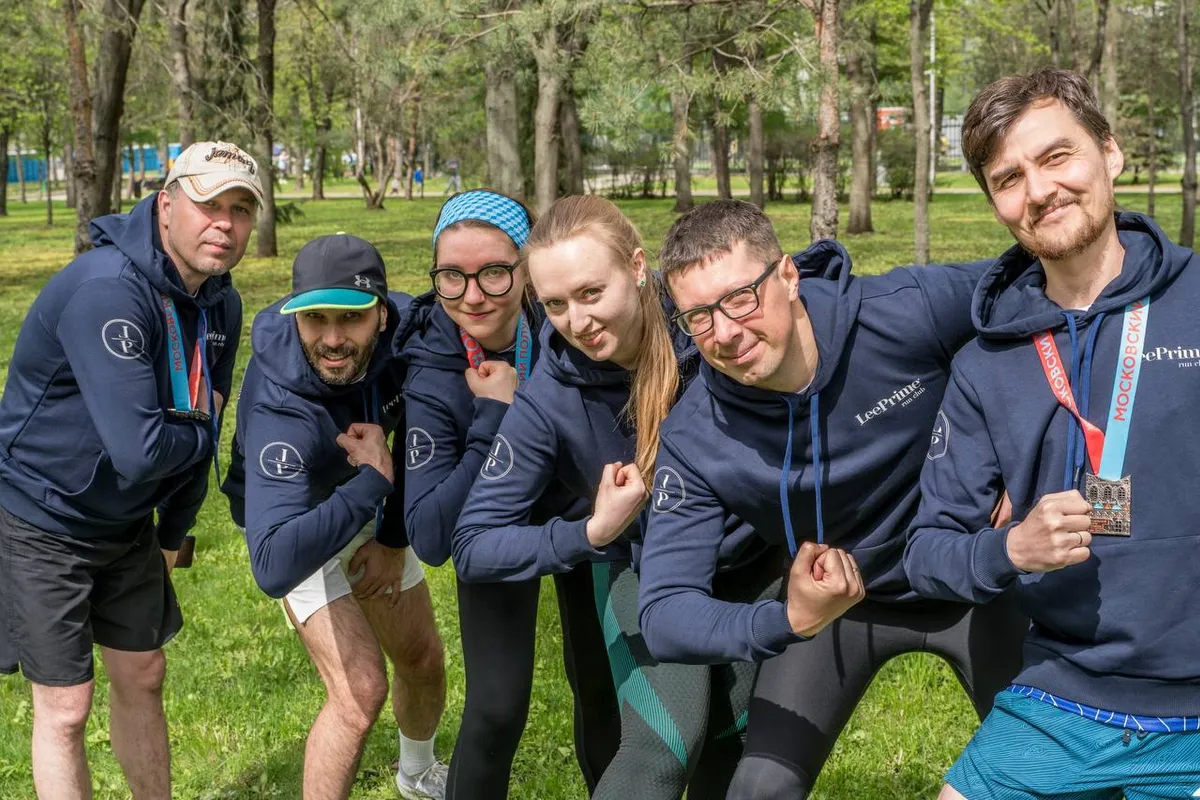
LeePrime run club is more than just a running club. It is a living community of like-minded people united by a passion for sport. Over the past year the team has established itself as an active and visible participant in the capital's largest marathons and races: from the dynamic Heroes League and the landmark Ramenskoye Marathon to the atmospheric Runfest Moscow and the classic Moscow Marathon.
Today we talk with Vladimir Dorokhin, founder of LeePrime run club, to find out what lies behind the club's successes, how new ideas for the team are born and what personally inspires him to conquer new sporting heights.
Tell us, please, how did the idea of creating LeePrime Run Club come about, and what goals did you set yourself at the start? How did it all begin?
It all began with a personal story. Much of what I bring into the company comes from my own convictions and healthy habits. My running story began in the pandemic year of 2020. Back then you could go outside for only two reasons — walking the dog and going to the shop. It was under the pretext of walking the dog that I started going out more often. It was dull sitting at home within four walls, and the mood of that period gave little cause for optimism. I wanted movement, hope and some positive moments in life. For me it was a chance to return to my roots and my sporting past, since my whole early life was connected with sport — volleyball, karate and other team sports.
I decided to try running. At first it was very hard — I remember my first two kilometres, I nearly died (laughs). I downloaded a running app with the goal of running five kilometres. By early June, as the COVID restrictions eased, I began going out for runs — in a hat, a mask and rubber gloves. Those were interval sessions. The app told me when to speed up and when to run.
Running is a very accessible sport. In essence you need just two things: trainers and desire. Everyone has a pair of trainers lying around somewhere, enough to simply start running. The main thing is to work with your intrinsic motivation and, above all, to overcome your own laziness.
Then, as your skills develop, comes the overcoming of yourself, especially on long distances over 15 kilometres. In essence running is a mental practice comparable to good meditation: when you settle into a rhythm and pace, your mind concentrates on the here and now, on the sensations of the body and the world around you. It is an excellent workout and a chance to be alone with yourself, with your inner self, and to learn to stay present in reality.
2020 was my first year of racing, after which came a break of about a year and a half. That September I saw for the first time how my friend Vladimir Zadorozhny ran a marathon — I felt that particular atmosphere. In 2020 I ran my first ten-kilometre distance. And I was seized by the idea of running a marathon.
When my friend moved to Moscow, the idea appeared of running together and proposing it within the company. Running with like-minded people is far more interesting than running alone — when you run alone there is sometimes not even anyone to talk to. But it is important to find a balance.
Initially I simply wanted to share my enthusiasm with colleagues, to share what is close to me. That same Vladimir Zadorozhny became my ally and helper in organising it. The idea was born of creating a running community within LeePrime Group. On the whole, its main aim is to add variety to employees' leisure and to draw in colleagues who share these interests. Clearly, such interaction helps build additional communication, which has a positive effect on work. When we meet outside the office we become a little kinder to one another, understand each other's interests better and get to know each other not as colleagues by job title but as living people.
As for goals — yes, no grand tasks were set at the start. But unlike our experience in 2023, the task now is to build a running community with 40–50 regular participants. Once we reach a certain number of regulars, we will be able to rent indoor spaces for out-of-season training. This season we plan to run until the hard frosts and heavy rain arrive. It is most comfortable to run at around +5 to +10°C, with the right kit.
There is a personal goal too — to run the Moscow Marathon, which is a genuinely serious challenge. It has eluded me three times for various reasons: from the COVID postponement through to an injury sustained practically just before last year's race.
What difficulties did you face while forming the team, and how did you overcome them?
Initially the main difficulty was pulling myself together, coming up with the idea and conveying it to people. The most important thing was for people to believe in the idea and to understand that it really was possible. I had to show it by my own example, announce it, put out a series of notices and invitations to join the running club. Even if only one person had come, a team would already have been forming — and that was very encouraging.
The strategy session in Busharino was a great help and served as additional publicity. As its leader, I did not miss the chance to reach the audience and raise the conversion of potential participants into our Telegram channel (smiles). But the primary task remained the same — to bring everyone together and convey the idea.
The second significant difficulty was working out where and when to hold the runs. Together with Vladimir we ran test sessions from the office on Kompozitorskaya Street to Gorky Park. We understood that running in a crowd through Moscow's narrow streets would be difficult — collisions were possible, given the participants' different levels of fitness.
It was interesting to watch the office's reactions — at first our neighbours in the building smiled at us when we came out after work in sports kit and trainers to run through the city centre. Fortunately there was a shower in the office, so we could freshen up after a run, which made things much more comfortable. Choosing the venue turned out to be the key moment. Running requires not only a good route but also the chance to recover and drink some water.
I remember the first runs from the office to the park, measuring distances, running into pedestrians and traffic lights — all of it was interesting experience. For Zadorozhny and me, who grew up in a provincial town, it was incredibly pleasant to run through central Moscow along the Garden Ring and to savour that moment of freedom. To recall childhood dreams — or rather, things we could not even have imagined: that in the evening the two of us would be running unhurried along the Garden Ring, and to understand that today we have that chance — simply to live.
We found an interesting solution for everyone — Gorky Park became our favourite venue. It has running routes, places loved by many athletes, a shower and a pleasant atmosphere — trees, people, the chance to eat something after training. Sometimes we even had a small cheat meal with hot dogs. Forming the team had its own challenges too. People are different, and everyone has their own expectations of training. We did not set a strict grading: if you run 7 minutes per kilometre, you do not have to go ahead of those who run 5:20 or 4:30.
The main principle is: run at your own pace. You could even call it the club's slogan.
When the team had formed, less than two months remained before the main event, the Moscow Half Marathon. Knowledge had to be passed on quickly: running technique, the ability to manage your effort, choosing the right pace. Monitoring the parameters was especially important — using devices to run by heart rate, not surging ahead and assessing your capabilities soberly.
Of course there were challenges in communication and in learning new skills, but that was more a matter of passing on experience than a problem. We did not set rigid limits — if someone wanted to run faster, they could; slower, likewise. The only unchanging rule was a shared start point and a finish point, where we always gather and do a cool-down — an important part of training.
Some difficulties arose from resistance, both internal and external. After a working day it can be hard to switch over and go to training, to gather with people when there is already so much important work to do. But the ability to organise your day properly is what makes it possible to hold a group corporate training session in the evening.
At the same time it is important to remember your personal limits: a coach will help, but everyone has to watch their own health, have medical check-ups and understand their level of fitness. Our running is not professional, but it does require attentive treatment of the body: proper nutrition, rest, a balance of loads. The main thing is to keep health in mind, otherwise running simply will not work. With injuries you need to listen to the doctors and give the body time to recover.
Ours is a non-commercial club and there are no membership fees to pay. The club was created around shared goals — bringing together people who are passionate about running. Discipline, though, must always be present.
Often, when we get something for free, our brain devalues it. So it is important to be able to feel grateful for what we have and for what is done for us. That is the essence of running — it teaches you to value simple things: a pair of old trainers, shorts, a T-shirt and intrinsic motivation. In time new opportunities and kit appear, but it all begins with the simple. Running has another quality: you get out of it as much as you put in.
Is there a race that has been the most memorable for the team?
I think the most important race is the first one. It is unrepeatable, because there is a great deal of adrenaline and a great deal of anticipation of the coming celebration of running. First of all, we got our own kit, because the team's appearance mattered a lot too. There was anxiety about its delivery — the kit was ready literally two days before the race, and we still had to try it on. What is more, the parcel first went to the wrong address, and there was worry about getting it there in time. All in all, in my view it is one of the most memorable, because it was the first big level of preparation, and going into uncertainty always costs extra resources. What mattered was that we came together, that participants joined who had not even bought a number, that supporters came to cheer. It mattered to the team, no matter which distance they ran; the event itself, the Moscow Half Marathon 2024, was important for us. There were first victories, there were joint runs of the half-marathoners with those running 5 kilometres, a team story of mutual support. And also the granting of wishes — because when you run between two Vladimirs, you can always make a wish that is certain to come true.
First of all I want to thank our whole first team — Maria Khamkova, Rafael Stepanov, Shakh Yuldashev, Irina Bakancheva, who came out for the first race, and Alexander Aryshtaev, who ran 21 kilometres. A separate huge thank you to the company for its support — paying for entry slots, helping with kit, flags and all the sporting paraphernalia. Returning to the club's development, I would like to build a regular core that is ready to gather and run twice a week.
The coach's role cannot go unmentioned. This is a person who deserves respect: their word in training is to be followed. But it is important to distinguish personal feelings from the coach's motivating actions; you have to understand that the coach gives instructions and recommendations that should be adhered to.
Discipline is choosing between what you want now and what you want most. (John Maxwell)
How has the club changed since it was founded, and what was the main event of the past year?
Last August I had to end my running season, but the club carried on. In September we managed to run the Moscow Marathon — one of the brightest events of the Russian running community. After that I had to take a long break from training. Coming back this year was harder — although much of it is already familiar and understood, the year itself turned out to be full of events.
We began trying to run in winter: the first runs in January and February, though they did not become regular. By mid-March we understood that the coming half marathon had to be run — the goals were set, the participants ready. Some remained among the merely interested, some took a temporary break for their own reasons. Coming back after winter was hard — many had put on extra kilos and their muscles were not prepared. But what matters is that we managed to run the Moscow Half Marathon successfully, the very race we had started with a year earlier.
The number of events our athletes take part in has grown considerably. Irina Bakancheva ran her first independent ten kilometres with a time of 1 hour 5 minutes at the Podari Zhizn foundation's race. That became a significant part of the club's life: not only traditional sporting events but also events connected with socialisation and spiritual support.
The club grows not only under the guidance of the coaching staff but also through everyone's personal initiative. What matters is that everyone can do what interests them while remaining part of the shared community. Support and motivation are always actively present in the club's chat discussions.
This year many new participants have also joined the club — not only company employees but also people close to us who share an interest in running and the club's philosophy. It is also important to understand that in running you can come and go, but a place here always remains open for everyone — no closed stories.
Something new: we have changed the training process a little. Drawing on last year's experience, we realised that alongside long runs and interval sessions we lacked general physical conditioning. So one session a week is devoted entirely to general physical preparation: less running, more squats, press-ups and stretching. That has helped strengthen the muscular corset, improve endurance and better our running results in competitive races.
This year we took part in a night race with a good result — I set a personal best, running 10 kilometres in 43 minutes 34 seconds. It was interesting to run through night-time Moscow in a free and friendly atmosphere.
Unfortunately we had to cancel our plans for the Kazan Marathon, but it remains a goal for next year — our partners are there, and maintaining those relationships matters to us.
There was also a series of regional events, for example the Ramenskoye Marathon. A woman from our community took part in it, and in August a group travelled to the Northern Capital half marathon in St Petersburg.
A highlight of this year was the team's return to the Moscow relay along the Garden Ring, which celebrated its 100th anniversary in 2024. For me it matters that the goals we set are always achieved: all the races produced results, often a little above the bar we had set.
This year also saw RunFest — a wonderful event that brought together the history of running and music. For me, as the founder of the company's musical group, it was especially meaningful — a chance to support the team, to perform and to enjoy the atmosphere.
What is the club's five-year development plan?
For the coming year we already have plenty of tasks: we are preparing for the Moscow Marathon and dream of ending the season in Sochi at the Sochi Marathon.
Sochi is one of the places where we are most present, and I am sure it is worth inviting the teams of the Pullman and Mercure Sochi Centre hotels to join us, and perhaps joining forces with colleagues from AVA Group — there are a great many runners among them.
It would be wonderful to stage a real flashmob, a team event where every group has its own branded kit. Incidentally, this year we have new equipment: new running and training sets, bright flags and the traditional hoodies for supporters. We invite everyone to support us at races, to take photographs together and, after the finish, to head to a café to celebrate. Among the fresh ideas born just now: to try in November to cover the route from Ski Village to the start village of the Sochi Marathon (smiles).
When people are waiting for you at the finish, when they rejoice at your successes — that is very valuable, it gives energy and inspiration to carry on. I encourage everyone who wants to support our team — come along, take part at least as a supporter.
Looking five years ahead, the most ambitious dream is to organise our own marathon or a series of races in the cities where our company is present. Every year a new city, a new route, involving not only employees but also our company's guests, building a tradition and a culture of team sport.
Vladimir, tell us, what is your favourite marathon?
— Well, of course, that remains my first one. But if we mean a marathon specifically, then it is White Nights. The mad St Petersburg atmosphere; I have not met such warmth from a city's residents in a long time. And it was the very first, and back then it was a night race. It will probably stay in my heart as my first step into the unknown. Most importantly, that it all worked out.

The best advice you have received in sport?
— Stay yourself, go towards your goal. And one phrase from karate, which I used to practise, is still in my head: "Defeat yourself — know yourself." And also: "If people talk behind your back, it means you are running out in front."